
THIS REVIEW CONTAINS SPOILERS.
It feels like a disservice to Park Chan-wook’s singularity that so many people (bar the Academy, but what do they know?) are comparing No Other Choice to Bong Joon-ho’s Oscar-winning masterpiece Parasite. Of course both films are fantastic, but surely we don’t have to suggest every Korean film is the same. I mean, No Other Choice is about a family struggling due to class and money, who resort to extreme methods to keep themselves afloat. And Parasite is about… a family struggling due to class and money, who resort to extreme methods to keep themselves afloat. Oh. But whilst they share DNA, they are extremely different in execution. In some ways, Parasite was a thriller masquerading as a black comedy; No Other Choice, on the other hand, is a black comedy masquerading as a thriller.
Man-su (Lee Byung-hun) is a family man, working middle management in a paper factory and admiring the cosy life he has built with his wife Miri (Son Ye-jin) and children – screen-addicted teen Si-one (Kim Woo-seung) and near-mute cello prodigy Ri-one (Choi So-yul). They live in Man-su’s childhood home, a brutalist mansion which he managed to buy a few years before. But soon there is trouble in paradise: Man-su is fired when an American company takes over and downsizes, and after over a year of rejections, failed interviews and literally begging on toilet floors, he is still unemployed and his family are making sacrifices to survive. Miri must give up her tennis lessons (gasp!), Si-one has to say goodbye to Netflix (shock horror!) and Ri-one cannot afford a cello teacher worthy of her talent (okay, this one is actually quite sad). But when they fall behind on their mortgage and their beloved house goes on the chopping block, Man-su resolves to find a more extreme method of job hunting.

Don’t worry baby, Daddy’s going to work at the murder factory.
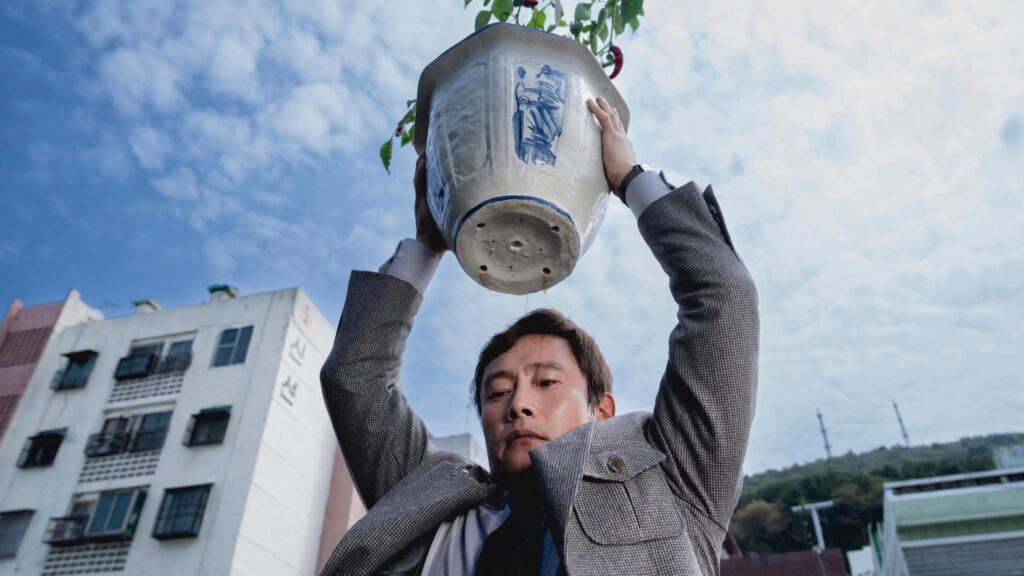
We live in a society where our lives are inextricable from our jobs, and Park Chan-wook takes this to its extreme. Man-su can’t just get a job anywhere; it must be in the paper industry. He isn’t just any guy, he was Pulp Man of the Year 2019, goddamnit! Man-su settles on up-and-coming Moon Paper, but the person standing in his way is macho influencer and manager Choi Sun-chul (Park Hee-soon). Man-su follows him and prepares to take him out via potted plant to the head… until he realises that this will not guarantee him the position. He has work to do. Using a fake job advert (a.k.a. everything you see on Indeed), he identifies the top candidates for Sun-chul’s job were he to… ahem… have an accident, and decides he is third in line. Killing only three people isn’t so bad; if I was killing to ensure I was the most qualified for a junior admin job in London, I would have to commit a mass genocide. But though Man-su’s idea is bloodthirsty, he is not necessarily cut out to commit murder, and thus begins his Looney Tunes-esque quest to kill his way to the top.
The first victim is Bummo (Lee Sung-min), a depressed alcoholic with an unfaithful wife, Ara (Yeom Hye-ran). Man-su, angel that he is, at least wishes to kill Bummo before he can uncover his wife’s affair… and fails spectacularly. Sneaking into his house, Man-su, Bummo and his wife have a wild confrontation loudly drowned out with the absolute banger “Red Dragonfly” by Cho Yong Pil (go listen, it’s elite). They scrabble for the gun like Bugs Bunny and Elmer Fudd, before Ara dispatches her own husband. It’s absolutely hilarious and gloriously drawn out, which is sharply contrasted with the second murder: Man-su’s execution of shoe salesman Ko Si-jo (Cha Seung-won) is lonely, fast and brutal. But Man-su can’t even look at his target, covering Si-jo’s face with his hand before making the shot. He embodies one of my favourite tropes: the hapless everyman-turned-murderer. Park Chan-wook switches deftly between the two styles of murder, demonstrating his adeptness in both comedy and thriller.
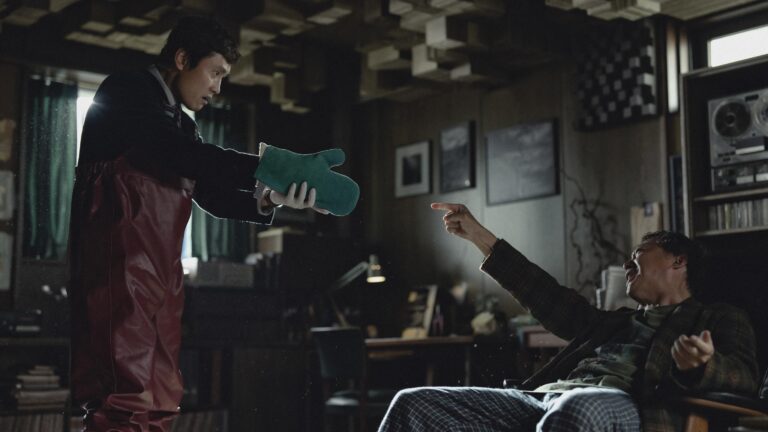
The worst fate for poor Bummo: death by oven glove.
Meanwhile, Man-su and Miri each suspect one another of infidelity. After a heated night at a dance party, where Miri dances with her hot boss (don’t worry, Man-su, you’re hot AF as well!) It is revealed that Man-su was an alcoholic and would beat Si-one whilst drunk (okay, maybe he’s slightly less hot after that admission). After a visit from two detectives to warn Man-su of the Paper Man Murders, Si-one sees his father preparing to dismember Si-jo’s body in his greenhouse, and tells Miri. Unable to go through with the act, Man-su instead coils up the body with wire (which is somehow more repulsive) and buries it under an apple tree in the garden.
Man-su leaves for his final “interview” with Sun-chul, the only obstacle to his new career. He arrives at Sun-chul’s house with several bottles of whisky, and proceeds to get his host absolutely plastered whilst subtly pouring his drinks away. But he can’t avoid drinking for the whole night: after being forced to chug a beer, Man-su uses his dutch courage to grab a pair of pliers and pull out his festering tooth that he couldn’t afford to have extracted. This to me is worse than any murder you could show on screen. Mouth things are… not my thing. With Sun-chul out for the count, Man-su suffocates him and stages the body to appear that Sun-chul choked to death on his vomit. Meanwhile, Miri digs into Si-one’s story (literally) and uncovers the body under the apple tree, confirming her suspicions of her husband. When Man-su returns she does not confront him, but is visibly uncomfortable with her husband’s touch.
Was it worth it, Man-su? (As we are about to find out, absolutely not). In a comedic turn of events, Man-su is exonerated when Bummo and Si-jo are implicated in each other’s disappearances. The film ends with Man-su achieving the job he killed so hard for, but when he gets to work it is a fully AI-run factory; he is the only human. He celebrates, hearing only the loud drone of the machines. Meanwhile, at home, Miri is shocked to hear Ri-one playing her cello for the first time; a private concert that Man-su is not privy to. Man-su has created his own personal hell, and now all he can do is relish in it.
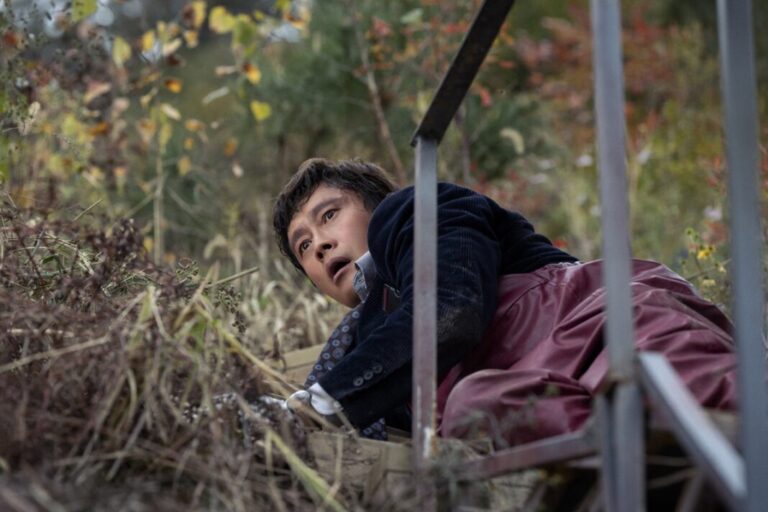
My face when I realise I have to work for the next 50 years.
Whilst the satire is masterful, I think the most impressive part of this film is its visual language. He wrings every drop of tension, unsettling weirdness and unconventionality out of his shots. From an abundance of creative crossfades and transitions, to filming at angles so off-kilter most would never consider it, to snappy editing and camerawork that swoops around with an omniscient eye, Park Chan-wook makes the audience uncomfortable by defying the expected. Cinematographer Kim Woo-hyung has done a stellar job of creating memorable images galore, that will surely stick in people’s minds long after the film has ended.
So what can we learn from this story – especially me, as a currently unemployed person? Firstly: I’m glad I’m not in South Korea’s job market right now (although is London that different?) Secondly: Man-su absolutely had other choices. Will tying ourselves so inextricably to our careers ever be anything other than negative? Surely we should want to be defined by our characters and actions, rather than what we happen to spend 40 hours a week doing in order to pay rent? With how many people are job hunting at the moment, it feels like there will always be five, ten, a hundred people more qualified than you. Man-su was a passionate gardener; why couldn’t he have done that full-time? Maybe we all need to take a step back and look at how we see our jobs in relation to our lives. I know far too many people who have turned their career into everything they are. And my god, I hope that never happens to me. That being said, if anyone knows anywhere that’s hiring, please let me know and I’ll send my CV promptly.
Director: Park Chan-wook
Cast: Lee Byung-hun, Son Ye-jin, Park Hee-soon
Runtime: 139m
Certificate: 15
Country: South Korea
Images: CJ Entertainment, Moho Film, KG Productions