
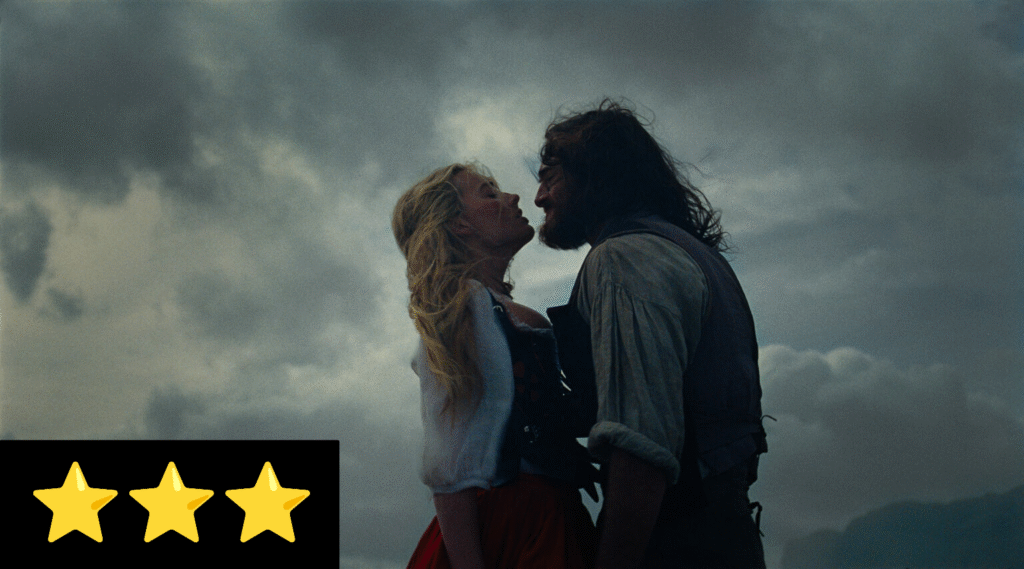
THIS REVIEW CONTAINS SPOILERS (for a 200 year old novel).
Look, if you’re going to turn Wuthering Heights, a gothic masterpiece about a tragic, twisted relationship between the doomed Catherine Earnshaw and downtrodden, volatile Heathcliff, into a psychosexual thriller – at least make sure it’s giving me David Cronenberg horny and not barely scraping Bridgerton horny. Emerald Fennell doesn’t even reach the bathtub-licking highs of her previous film Saltburn (of which I continue to be a defender – does no-one like fun anymore?) Controversy has plagued this adaptation since its announcement, and I will put my hands up and say I am not particularly qualified to discuss those aspects in depth. I read the novel seven years ago so a lot of the details are hazy to me. Furthermore, any attempt to class this as a faithful adaptation is rebuked by Fennell herself, who readily admits this is a response to how she remembers reading Emily Brontë’s novel as a teenager, rather than a slavishly faithful recreation. Of course this was always going to be controversial, and has come with plenty of criticism: the question of Heathcliff’s ambiguous race, whether Fennell understood the novel’s themes, and if she personally wanted to antagonise every Brontë-head in the world. But like it or not, the film is here, so for this review I would like to do what Fennell herself has done – remove the idea that this is an adaptation of Wuthering Heights, and treat it as its own entity. So, in that vein, I have to say – unfortunately, this film does not have the sauce it requires to pull off Fennell’s vision.
Firstly, let’s get the positives out of the way: this film looks fucking incredible. Fennell clearly has an eye for visuals, and between the bonkers production design and Linus Sandgren’s inspired cinematography (so many juicy close-ups!) there are plenty of eye-gasms to marvel at throughout the runtime. This might just convince me the art of film lighting isn’t completely dead. We are initially introduced to the titular house, an imposing gothic mansion set in the misty Yorkshire moors, framed by jagged black rocks. It’s a wild departure from previous adaptations, but frankly I enjoyed this depiction of the Heights in all its gothic glory, along with moody, high-ceilinged interiors, red window panels and checkerboard floors. I like a consciously setty set, and the completely improbable architecture spoke to a deep love of Expressionist design that sits in my heart. By contrast, Thrushcross Grange, where Cathy lives after marrying Edgar Linton, is a grand but grotesque Georgian manor filled with kitschy anachronistic design, from blood-red corridors to a bedroom upholstered with recreations of Cathy’s flesh. The costumes are equally impressive; I admit, when the first pictures were released I was sceptical, but they work well in context, especially when you see the difference between Cathy’s more humble dresses at Wuthering Heights contrasted with her opulent but tacky costumes at Thrushcross Grange. Even the typography is impeccably designed: the title grows out of locks of hair, covering the image of the desolate moors and a river running red leading from the house.
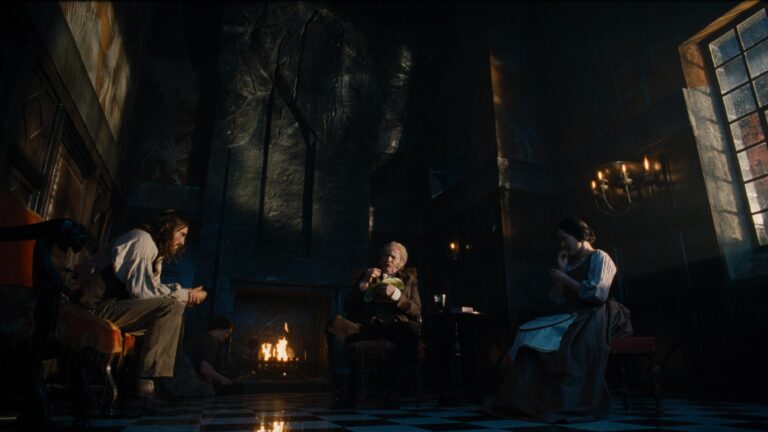
Full tea, I 100% deeply desire to live in this house.
So visually I cannot fault the film, but style can only get you so far, and this is where the film starts to become deeply flawed. The biggest issue, frankly, is that it just never reaches the grandeur or torment of Brontë’s novel, and the central relationship is unfortunately not believable enough to carry the story. I’m sure many will put this down to casting, but I think the writing mainly does the actors a greater disservice. Admittedly Margot Robbie was always going to be miscast as Cathy, and her distractingly-janky English accent (not even an attempt at Northern!) makes it hard to place her within the film’s world. Her characterisation is, in fairness, fittingly unlikeable, and her bratty tendencies are played up well. But the film is far too reticent to make you truly hate its main characters, and they both suffer deeply for this, Jacob Elordi moreso.
In my mind, Elordi absolutely has the juice to play Heathcliff, but he’s just never bad enough to believe his eventual descent into “evil”, and the film doesn’t do enough to convince us that he and Cathy share the same soul either. In the novel, Mr. Earnshaw dotes on Heathcliff and it is Cathy’s brother Hindley who abuses and eventually demotes him to servant, so you can see how the resentment grows in him and manifests as violence. The film removes Hindley so everything falls on Mr. Earnshaw (an excellent Martin Clunes), who is an abusive drunkard, so Heathcliff never has a fall from grace to show why his thoughts darken. His temper is barely shown, and the film falls into the trap of constantly telling us that Heathcliff is volatile, but if we never see this, how can we believe it is the case? This is stuff we were taught in a Year 7 English class, damnit! There is also no adequate foil to make Heathcliff seem dangerous, as Cathy’s eventual husband Edgar Linton (a wasted Shazad Latif) is given little backbone or purpose in the story, so he is never a real obstacle to their relationship. It’s a symptom of a script that feels like it’s going through the motions of plotting rather than letting the story feel character-driven, and Fennell skips over the development of Cathy and Linton’s relationship, which again just hurts the portrayal of Heathcliff further.
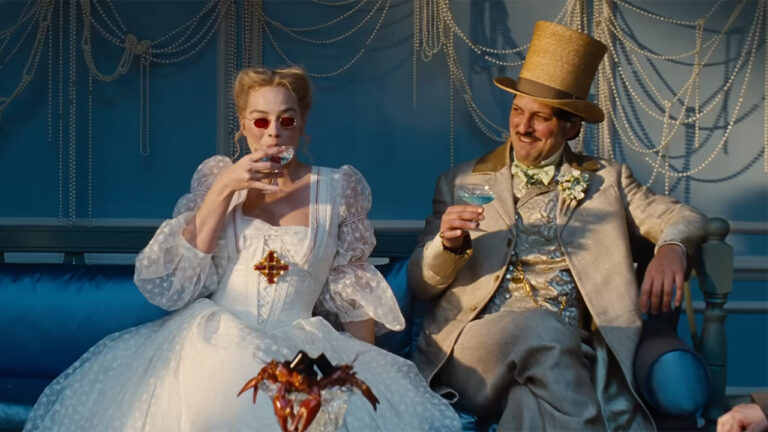
Emerald Fennell fully ran wild with this production design and I am TOTALLY HERE FOR IT. The crabs are wearing top hats!
The real stars of the film, then, end up being the side characters. Martin Clunes is wonderfully despicable as Cathy’s mess of a father (Clunes revival incoming?) and Hong Chau delivers an expectedly strong performance as Cathy’s long-suffering maid Nelly (unfortunately her full story as Cathy’s punching bag remains tantalisingly out of reach from the film’s scope). Though the character choices Fennell makes for Isabella – in the novel Edgar’s sister, here his ward – are… questionable at best (turning an implied abusive relationship into a BDSM human puppy fantasy is probably the film’s most egregiously harmful misreading of the novel), Alison Oliver plays the role fantastically, balancing her initially irritating naivety with her later descent into resentment towards Cathy and lust for Heathcliff. If I hadn’t known, I never would’ve recognised Oliver from her role in Saltburn; but, much like the rest of the side cast, she is whisked away before the film can confront the implications of her relationship and promptly forgotten about. Furthermore, by making her Heathcliff’s willing victim, it continues to absolve him of guilt and keep him from hitting the truly despicable lows the character should stoop to. It’s infuriating as there are so many interesting threads in the film that get pruned in service of the central relationship, which is just not as interesting as anything else in the film.
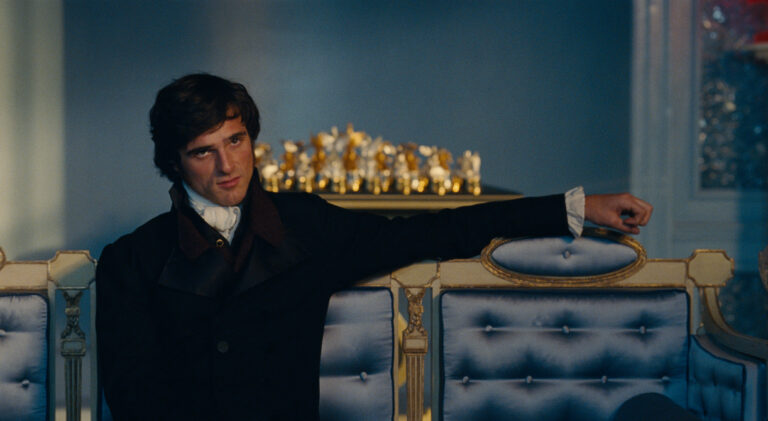
Is Elordi a good Heathcliff? Unfortunately, not really. Is he still extremely attractive? Of course!
Finally, I think we need to address the elephant in the room: the horniness. Or, in my opinion (I can’t believe I’m saying this), the lack thereof. Don’t get me wrong, there’s plenty of bonking, but I feel like Fennell promised us a wild ride, and though Saltburn is, in my opinion, hardly as weird as the general public ever made it out to be, it at least delivered a satisfying level of deranged in its lustfulness, with plenty of period oral sex and grave fucking (AKA fun for the whole family). “Wuthering Heights”, on the other hand, is depressingly vanilla. The opening scene, depicting a hanged man getting a boner in his final moments, makes a promise that the film cannot deliver on – but even this was reportedly cut down after test audiences reacted negatively to a nun fondling the corpse’s erection (why oh why do we let such boring people into these screenings? And then listen to them?) There are a couple of instances of pet play – the farmer Joseph and Cathy’s maid Zillah engage in some saddle action, and the aforementioned Isabella/Heathcliff whatever the fuck that is, but literally there is more wild sex in Bridgerton Series 1 Episode 6 than anything Cathy and Heathcliff engage in. More of the eroticism comes from characters sticking their fingers into sexually suggestive substances (broken eggs, jellied fish, flesh walls) than the actual act of intercourse. Maybe my expectations are just too high, but I was hoping for something closer to Cronenberg’s Crash than this baby’s first erotic thriller. Despite a girl coming out of my screening loudly proclaiming this was “The weirdest film I’ve ever seen”, I can assure you that it is not. It wouldn’t even make this Letterboxd list I created of films to show someone who thinks Saltburn is the weirdest film ever made. It’s a shame Fennell basically ripped the grave scene from Wuthering Heights out to use in Saltburn, which means we don’t even see Heathcliff dig Cathy up to lie with her corpse, instead electing to stage the scene far-too-tastefully at Thrushcross Grange. It’s hard to say this, as I am but a humble gay man, but Jacob Elordi wasn’t even really doing much for me here, even with the gold tooth and earring. Sorry, guys, but he’s hotter in Frankenstein!
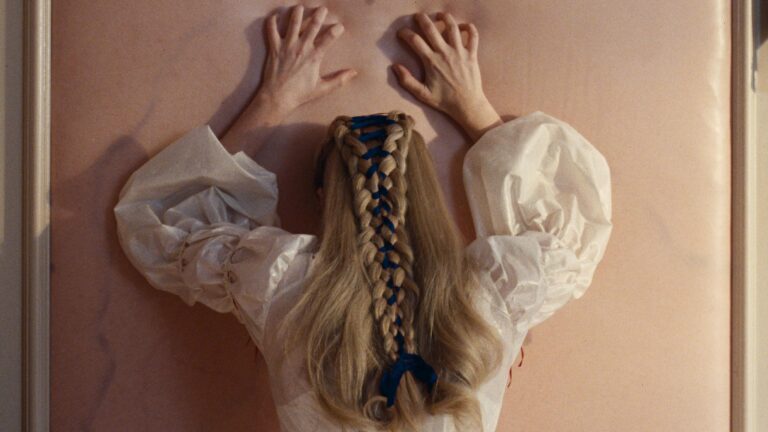
If I married a guy and found out this is how he chose to design my bedroom, trust and believe we would be annulled before you could say “Wuthering Heights”.
Overall, I am not going to use this film as a condemnation of Emerald Fennell. I think there is far too much hatred and bad-faith reactions to her films, and whilst there is plenty of criticism to be levelled at “Wuthering Heights”, I would still watch anything she directs in the future. But, for the love of God, please maybe try working with another writer, or stick to original scripts. It’s a shame that this is a film of two halves: genuinely some of the best production design and cinematography I have seen in a long time, that would be more than deserving to have Oscars thrown its way next year. But this eye-popping veneer hides little of substance inside. “Wuthering Heights” should be a brooding, angry story of hatred, torment and possession, but this film never dares to delve into those themes and instead stages a psychosexual game that is never as interesting as you want it to be. That being said, there is one light that makes this film’s existence more than worthwhile: an absolutely banging soundtrack album by Charli xcx, particularly the lead single House featuring John Cale, a euphoric gothic masterpiece that scores the film’s opening perfectly. Hearing that in the cinema, paired with the film’s stunning photography, might just have been worth the price of admission. Shame about… well, everything else. Sorry to the real freaks out there; there’s little for you here.
Director: Emerald Fennell
Cast: Margot Robbie, Jacob Elordi, Hong Chau, Martin Clunes, Shazad Latif, Alison Oliver
Runtime: 136m
Certificate: 15
Country: United Kingdom
Images: MRC, LuckyChap Entertainment, Lie Still, Warner Bros. Pictures