
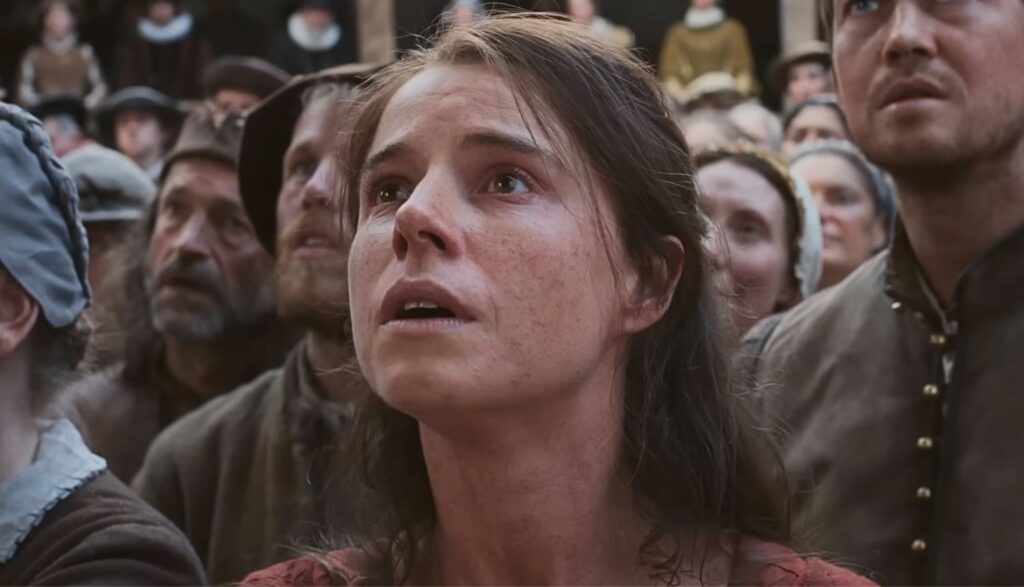
Let’s just establish, for the purposes of this review, that William Shakespeare’s Hamlet is like… the greatest work of literature in the English language. You can agree to disagree, but for the purposes of watching Chloé Zhao’s Hamnet, it is best to go in with that mentality. The film tells us at its opening that Hamlet and Hamnet are functionally the same name – much like its protagonist Agnes (pronounced An-yez) Shakespeare (Jessie Buckley), who most will more likely know of as Anne Hathaway. Anne, amongst other things, bore three children with the Bard and starred in The Devil Wears Prada. (Now imagine the meta madness if the other Anne Hathaway had played the lead in this film!) If you’ve seen the trailer, you already know every plot point in this story so I’m not going to mince words: this is a film about the relationship between Shakespeare (Paul Mescal) and Agnes, and their subsequent grief after the unexpected death of their 11-year-old son Hamnet from the plague. I knew going in that there was a 99% chance of crying, and cry I did. Cry I did a lot. But more on that later.
Unlike Maggie O’Farrell’s novel, which she adapted for the screen alongside Zhao, the film relates Agnes & Will’s story in chronological order from their first meeting at Hewlands, Agnes’ home. She is known about town as a witch, the daughter of a woman who supposedly came from the woods, and has retained her now-dead mother’s skill as an apothecary. Will and Agnes bond when he tells her the story of Orpheus and Euridice – you know he’s down bad when he’s pulling out the ancient Greek rizz. But they know that neither of their parents would give consent to their union – Shakespeare was only 18 (although you wouldn’t know it looking at near 30-year-old Paul Mescal) and Agnes was 8 years older and despised by her stepmother. So they take matters into their own hands the good old fashioned Tudor way: by fucking in a shed, getting Agnes pregnant, and trapping Will’s father into a deal with her brother Bartholomew (Joe Alwyn) to keep both families’ reputations clean. Agnes is finally free of the oppressive Hewlands and moves in with Will’s family, before running to the woods to give birth to their first child Susannah.
Soon Agnes is pregnant again, but Will is restless, drinking heavily and torturing himself for his inability to produce art (been there, done that). So he does what any self-respecting husband would: abandons his wife and child in Stratford to go and seek his fortune in London! (Disclaimer: it is Agnes that proposes this solution.) Now Shakey is getting his plays produced and planning to move his family to the Big Smoke (or whatever London was called pre-Industrial Revolution), but Agnes is consistently reluctant. On the night of her second labour a flood prevents her from going to the forest, which she sees as a bad omen. She has prophesised that she will have 2 children standing at her death bed, and when twins are born, it is abundantly clear where we are heading (unless you haven’t seen the trailer or know nothing about the film, which is unlikely).
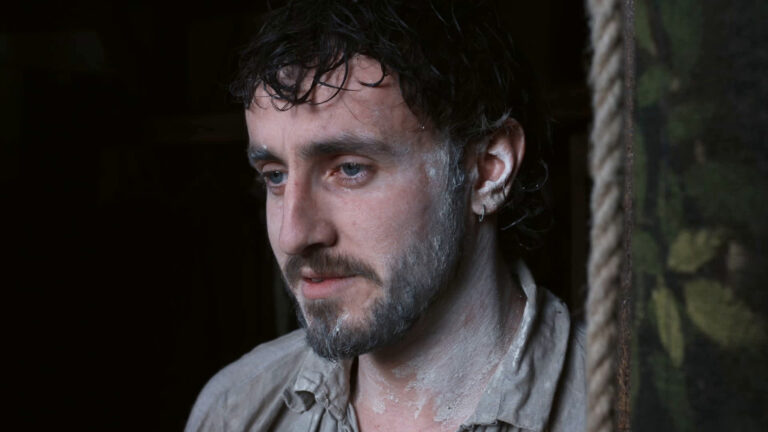
Paul Mescal, still only the 2nd hottest actor to play Shakespeare (big up Mat Baynton).
Jump-cut 11 years and the twins, Judith and Hamnet, are now mischievous little scamps, crossdressing gleefully and reciting scenes from their father’s plays. And the film unleashes its secret weapon: the best damn child acting you might have ever seen from the utterly adorably heartbreaking Jacobi Jupe. You just want to hold him and tell him it will be okay! His blue eyes pierce your soul! Chloé Zhao you are evil and must pay for your crimes! Hamnet wants to grow up and be a player in his father’s theatre, and is disappointed when Will “must” return to London. And soon after he leaves, disaster strikes: Judith is struck down by plague. Agnes throws herself into curing her, but fails to see that the illness is creeping into Hamnet too. That night, whilst Agnes sleeps, Hamnet comes down and lies with Judith. Suddenly, he sees a figure in the room – death stalking the children – and implores it to take him instead.
There is a divide between the critics of this film: is it truly emotional, or emotional manipulation? Frankly, I find it a bit stupid to criticise a film about grief for – checks notes – being sad. Yes, I understand it is more about the construction of the film with the intention to elicit tears, but how can anyone watch a little boy beg for his sister’s life in place of his own and not be utterly broken? The next day Agnes tries to save Hamnet but it is too late, and he dies in agony in her arms. When Will returns, his joy at seeing Judith alive is quickly destroyed as he learns of Hamnet’s death, and gives the most depressing reading of the line “That’s my boy!” imaginable. I can picture it now, situated next to Daniel Day-Lewis’ “I’ve abandoned my child! I’ve abandoned my boy!” in a TikTok “Best Acting” compilation. Agnes is feral, screaming in torment, but Will immediately internalises his grief and runs back to London the next day. Typical man.
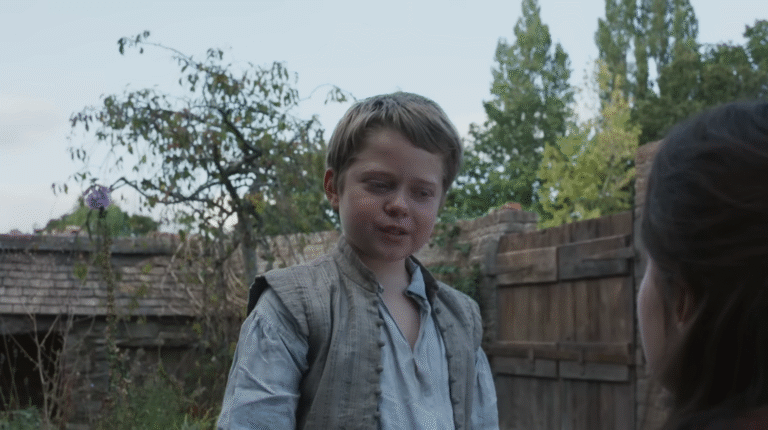
Jacobi Jupe: the face of emotional manipulation.
Despite this anvil of depression dropping on our heads, I found the film to be quite a well-paced building of emotion. Hamnet’s death was shockingly visceral and certainly drew the tears out, but it is not the emotional peak – Zhao saves that for the end. As Agnes spends the next few years wallowing in her grief, Will throws himself into his work, leading to conflict when she criticises the way he is mourning. And when she receives word of his new play – The Tragedie of Hamlet – her trip to London with Bartholomew seems solely to see how her husband has besmirched their beloved son’s name.
O’Farrell’s book holds its Shakepeare card fairly close to its chest, but Zhao’s film is a little more loose about referencing the Bard. No, it doesn’t always work – Shakespeare contemplating suicide and quoting the To be or not to be speech is, admittedly, a choice (although not more of a choice than Francis Ford Coppola introducing Adam Driver’s character in Megalopolis by having him deliver that entire speech in complete silence. Yes, that actually happens.) But by extending the final scene where Agnes watches Hamlet, Zhao changes the context entirely. The novel ends with the ghost of Hamlet’s father – played by Will himself – reciting the line “Remember me”. But the film pushes it further. Initially Agnes is sceptical of the play, horrified that the actors are saying her son’s name out of context. But when Hamlet (the ingeniously cast Noah Jupe, brother to Jacobi) appears, hair golden like her son’s, and recites the most beautiful words put down in the English language, she sees something new: the expression that Will could not verbalise. At its end, scored by Max Richter’s weepy On the Nature of Daylight, Hamlet dies from Laertes’ poisoned blade (spoilers for a 400-year-old play, sorry!) and Agnes reaches out to take the actor’s hand, prompting an emotional response throughout the audience. In a moment all becomes clear: Will has immortalised his son and let millions, if not billions, share in his suffering over Hamnet’s death, even if they don’t know it. This is the film’s emotional peak, and about the time I lost all control and started ugly-crying in the cinema. A word of warning: bring a pack of tissues to this film! Agnes sees a vision of her son crossing over the void into death, with one last look back at Euridice, and she laughs. Finally, Agnes and Will seem to have been reunited in their processing of grief.
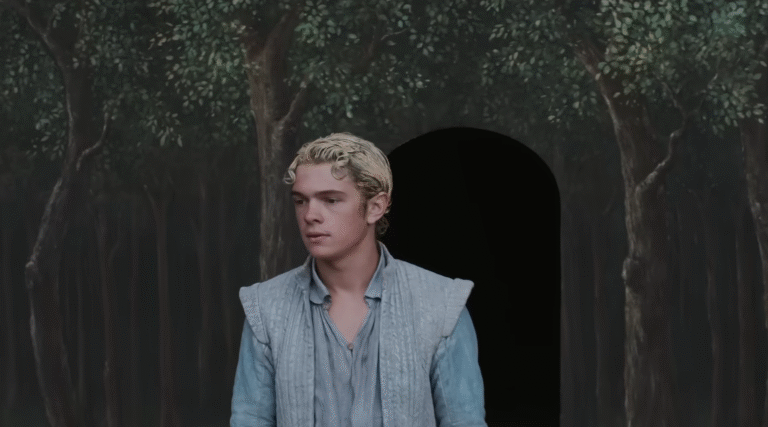
I’ve been so lucky, I am the prince with gold hair…
I’m sure there are some minor criticisms I could draw out of this film, but in terms of emotional response, it’s like being hit with an atomic bomb. The last film that made me cry this much was A Real Pain, and sometimes that full-body possession is what makes art truly great. It doesn’t even matter that this is all essentially fanfiction dreamt up by a writer. Maybe it is purely a coincidence that Hamnet and Hamlet share a name – or maybe Shakespeare poured his heart and soul into creating a work that will live on for centuries to come, and eventually be complained about by students who think it’s too long and has no relevance to their modern lives. But grief is a permanent state of human nature; everyone dies, and everyone experiences grief. It pierces through the veil of history. Chloé Zhao is not the first to capture this on film, and she certainly won’t be the last. But by showing this different side of a figure we all know – and one we are likely less familiar with – she has crafted a tremendously powerful film rooted in the natural world that will surely speak to many, many people. And if that comes with a well-deserved golden statue for Jessie Buckley in March? Well, so be it.
Side note: can I have a mini rant about cinema etiquette? The man in front of me at this showing seemed to get his phone out at EVERY SINGLE emotional moment. Hamnet is dying in his mother’s arms? PHONE. Agnes is watching the play and processing her son’s death? PHONE. I think we need to start shaming these people for their inability to sit and watch a film for 2 hours. Why even bother coming to the cinema if you clearly don’t care?
Director: Chloé Zhao
Cast: Jessie Buckley, Paul Mescal, Emily Watson, Joe Alwyn, Jacobi Jupe
Runtime: 126m
Certificate: 12
Country: United Kingdom, United States
Images: Hera Pictures, Neal Street Productions, Amblin Entertainment, Book of Shadows, Focus Features, Universal Pictures
Pingback: HomoFilmBro’s 2026 Oscar Best Picture ranking – homo film bro