
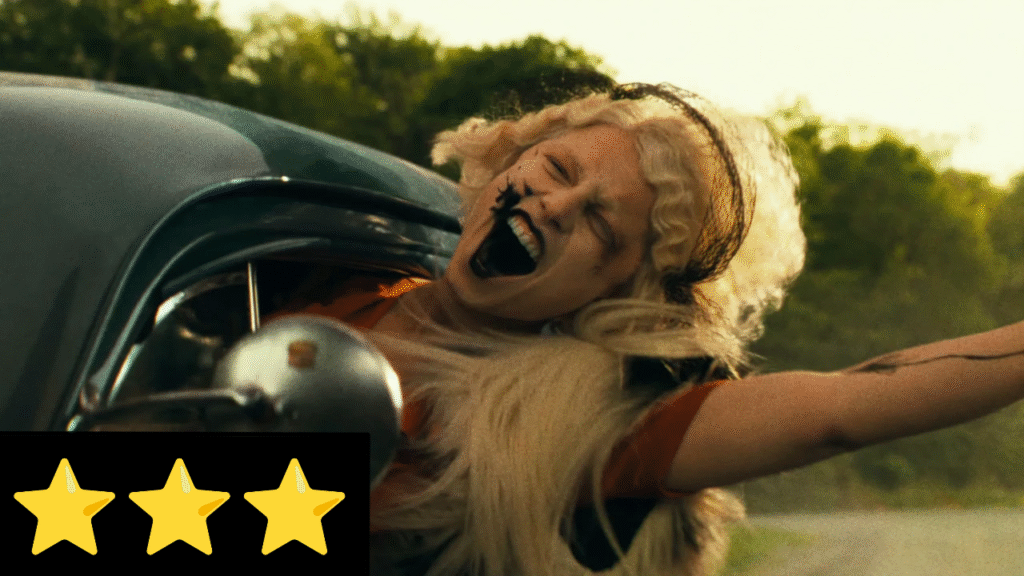
The Bride! – a beautifully designed Gothic ode to 1930s gangsters, monster movies and Old Hollywood glamour – should appeal to me, and in large parts it does. When they hit you with a surreal dance sequence (thankfully considerably more restrained than its uglier cousin, Joker: Folie à Deux) or illicit partying with the queers under a bridge, I can see what it’s getting at. And when Gyllenhaal leans into the spoofier elements of her story, it starts to make sense. But then it hits you with a meaningless monologue from Mary Shelley’s ghost, or a girl power moment that seems curated for YouTube Shorts. As a male reviewer I don’t want to patronise; I think this film does female rage very well, allowing Buckley to go ham as she calls out the mobsters murdering her friends. But the film never goes particularly deeper than, “Maybe women shouldn’t be silenced,” and I don’t think it’s outrageous to hope in 2026 that proudly feminist cinema might have a little more to say.
The film immediately opens with a logical fallacy (bear with me) as it tells us that Mary Shelley wrote Frankenstein in 1818 “on a dare” (which I’m not sure is strictly true), and has Shelley’s ghost addressing the audience from beyond the grave. She goes on to possess Ida (Buckley), a young moll who promptly goes batshit insane, switching between her natural Chicago twang and a vaguely questionable English accent, and incoherently babbling words that sound smart because that’s what writers do. Soon after she takes an accidental trip down some stairs and winds up in an early grave. Cut to Frankenstein (Christian Bale, and yes in the film they call the Monster “Frankenstein” just to annoy English students), who approaches Dr. Euphronius (Annette Bening), a mad scientist hiding under a false masculine identity, to cure his male loneliness issues with an undead Bride. Apparently no-one wants to shag monsters, even when they’re Christian Bale, which I find quite hard to believe. I guess some people only think monsters are sexy when they’re Jacob Elordi.
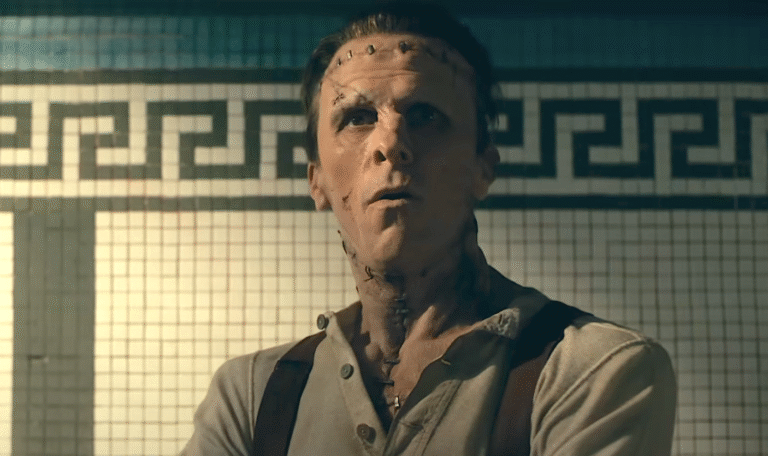
We need a crossover sequel so Christian Bale and Jacob Elordi can see who out-mogs each other.
But hang on – the film has established Mary Shelley as a character and Frankenstein as a recognised novel. Then it goes to the trouble of telling us the real Frank was created in 1819, in Ingolstadt – following Shelley’s novel ironically closer than Guillermo del Toro – but my brain is already starting to break. Did Mary Shelley writing about Frankenstein bring him into existence? Or did a doctor who happened to be called Victor Frankenstein create a monster a year later in a completely unrelated incident? The film doesn’t even attempt to paper over any ravines in this logic, and as a character Bale’s Frank is much more indebted to the Boris Karloff portrayal than the original novel. In contrast to basically every other man in the film, he is generally sensitive and kind, enjoying the films of Hollywood star Ronnie Reed (nepo brother Jake Gyllenhaal) and imagining himself in the movies (he just like me for real). But when Ida is re-invigorated by Euphronius, he lies to her and tells her they are married, which I’m sure won’t have any bad results down the line!
Soon after Frank and Ida get into a run-in with some nasty men which results in a whole lot of curb-stomping, and they become front-page news. The two murderous monsters must go on the run, and Frank naturally wants to start hitting up locations featured in Ronnie Reed pictures, because he’s a true cinephile. If Frank were alive today you know he’d be a fiend for Letterboxd. Meanwhile, Ida starts a literal riot girl revolution as women paint her signature ink splatter on their faces and start murdering the men who’ve done them wrong. It’s not the worst idea, but the film is very limited in its portrayal of whatever the hell this means for the world; the pool of women getting in on the movement seems quite small, and also weirdly implies that no-one was particularly fighting back against the patriarchy until Ida unwittingly started the movement, which is just plain wrong. But Ida and Frank just want to keep careening around the country, going to cinemas and falling in love.
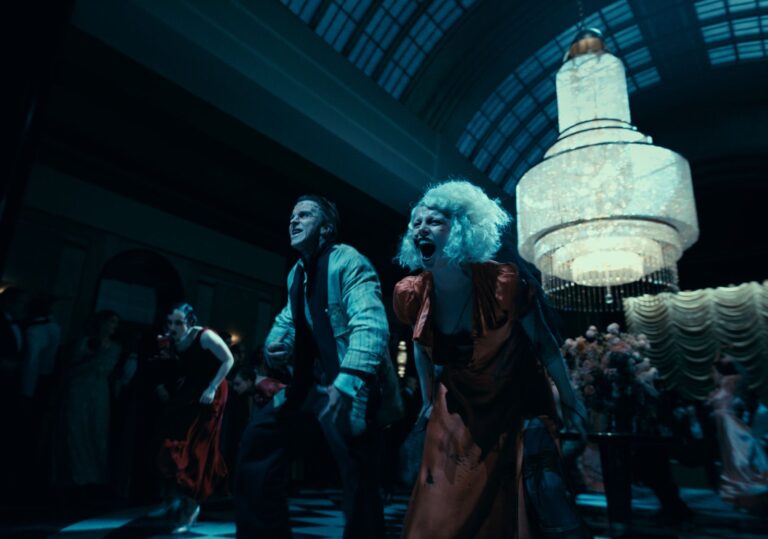
Joker and Harley want what they have so bad (a better film).
They are also being pursued by two detectives whose purpose in the story seems to be to add an unnecessary half an hour to the runtime. Jake (Peter Saarsgard) is a cop outclassed in intellect by his “secretary”, aspiring detective Myrna (Penélope Cruz). They have a fun dynamic but could have easily been excised without complaint. Despite Jake having a previous connection to Ida it doesn’t seem to impact anything, and you could’ve easily done Myrna’s story as a solo character. All Cruz is really there to do is serve bob and have a tell-those-nasty-men-who’s-in-charge moment at the end, which again seems pretty curated to go viral on TikTok. The feminist scream Mary Shelley promises at the start can be heard occasionally, but mostly it’s pretty surface-level “yass queen good for you” moments.
Also, John Magaro is in this as a gangster working for corrupt kingpin Lupino (Zlatko Burić), which you would be forgiven for forgetting since he appears in the opening scene and then vanishes again for at least a good hour. His presence also barely impacts the story, and I really start to wonder how the hell this film got so convoluted. If Gyllenhaal had just stripped it all back, focused on the Bride and Frank’s road trip and allowed the whole film to be a Bonnie & Clyde/Thelma & Louise tribute with a bit of Old Hollywood movie love thrown in, I imagine it would be a much stronger film. But as it stands it seems Gyllenhaal made her own monster from about three different films, resulting in a mess that is bloated as a dead body and deeply unfocused, even if it can be quite fun to watch. I can certainly see this becoming a future cult classic, a midnight movie which will gain appreciation for its camp elements as well as Buckley and Bale’s performances. But from a critical perspective, it just ain’t very good.
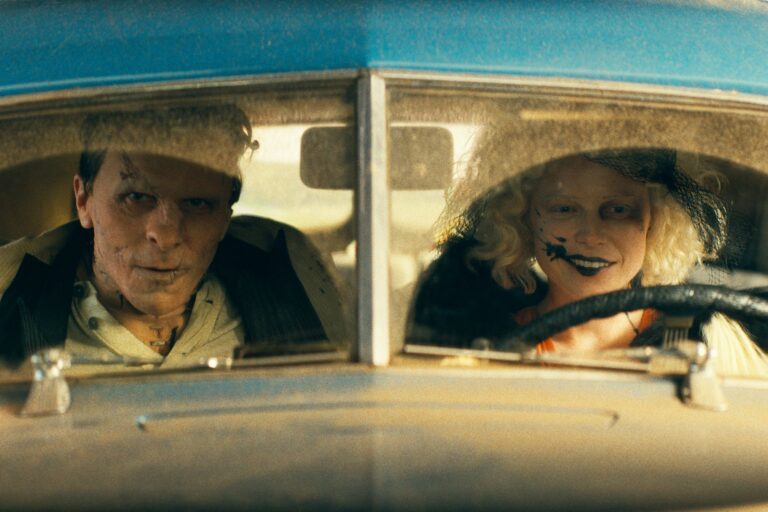
This is Thelma & Louise after they went down the canyon at the end of the film.
Ultimately, Gyllenhaal doesn’t seem able to decide whether this is a spoof or a serious love story. If it was 10x as bonkers I could see it working, or if they had actually just nailed down a more solid, coherent plotline that wasn’t so scattered. It’s pretty visually arresting and the production design is faultless, but much like Emerald Fennell’s Wuthering Heights, a pretty picture does not make up for a poorly conceived story. The film also doesn’t step out of the feminist box it presents itself in: we know women deserve a voice, we know they should not be victims of male violence, and frankly I don’t think anyone who believes otherwise is going to watch this film since the marketing alone makes those stances clear. Gyllenhaal’s film has the right to say what it wants, of course, but I don’t think I’m asking too much to feel like I’m being intellectually challenged by a film that purports to be a radical feminist scream. The Lost Daughter proved Gyllenhaal has sauce, and I don’t think this is a completely failed experiement; but much like Frankenstein’s monster, I wouldn’t say the results of Gyllenhaal’s work are exactly what anyone hoped for.
Director: Maggie Gyllenhaal
Cast: Jessie Buckley, Christian Bale, Annette Bening, Penélope Cruz, Peter Saarsgard, Jake Gyllenhaal
Runtime: 126m
Certificate: 15
Country: United States
Images: First Love Films, In the Current Company, Warner Bros. Pictures