
THIS REVIEW CONTAINS SPOILERS.
It’s hard out there for those of us with wide-reaching tastes in film. I mean, I love horror, musicals, surreal films, black comedies, satires, fantasy, live-action, animation, stop-motion, you name it. But surely there’s no film out there that combines all of these things into an explosive Smörgåsbord of weirdness… right?
Wrong! Takashi Miike’s 2001 film The Happiness of the Katakuris has all this and more stuffed into its 2-hour runtime. Best known in the West for his horror films Audition and Ichi the Killer, Miike spent about a decade churning out 3-5 films per year, and I guess this one got a little lost in the mix as it seems to be much less well known (it has about ⅛ of the number of watches on Letterboxd as Audition). Combining melodrama, fantasy, horror and black comedy, the film is a remake of South Korean picture The Quiet Family, but Miike turns up the zaniness by 1000000%. What results is surely divisive; it doesn’t always work, but if you’re into it then it’s wildly entertaining – and utterly unpredictable.
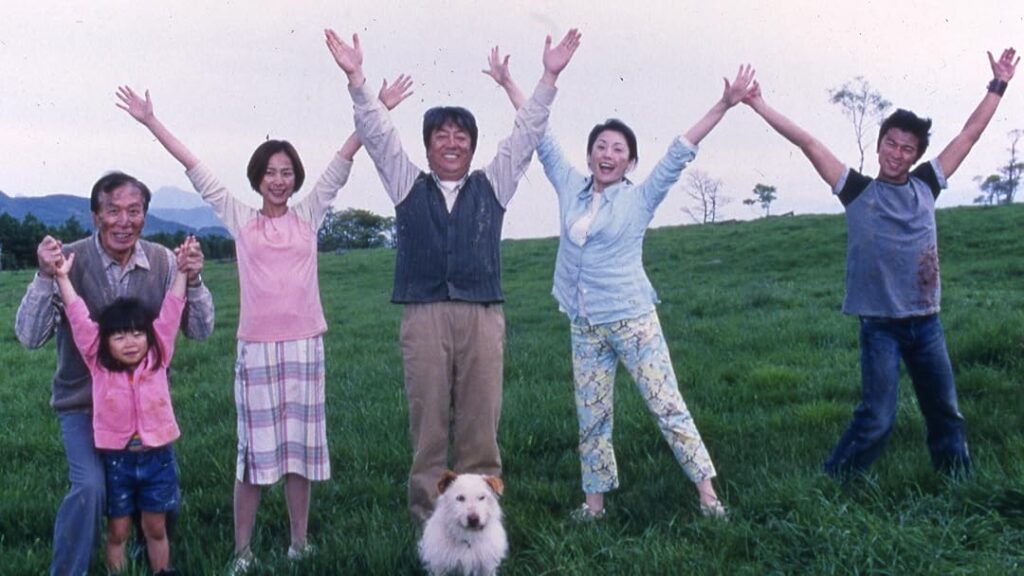
The film opens with a claymation sequence, in which a small devil-like creature rips out a woman’s uvula and then gets eaten by a bird. You might be wondering, as I did, what relevance this would have on the rest of the film. Well, as it turns out, absolutely none, as this is never mentioned again. We instead meet the Katakuris, a four-generational family running a failing guesthouse in an isolated rural area, hoping a road will soon be built and bring paying customers. Narrated through the eyes of child Yurie (Tamaki Miyazaki), the family are dysfunctional but ultimately loving. Patriarch and matriarch Masao and Terue (Kenji Sawada and Keiko Matsuzaka) are trying to hold everything together; their daughter, Yurie’s mother Shizue (Naomi Nishida), is divorced and falls in love too easily; their son, Masayuki (Shinji Takeda) is on the brink of disownment due to his criminal past; and Yurie’s aging great-grandfather Jinpei (Tetsurō Tamba) mainly wants to throw sticks at birds. Typical old man.
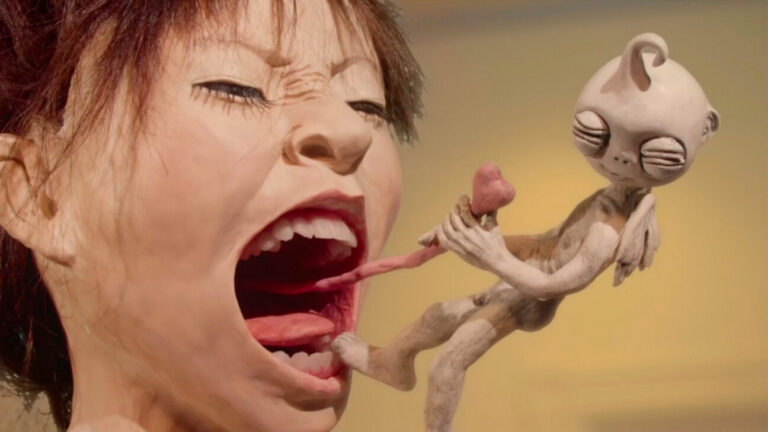
This is literally not addressed at any point in the film. But hey, it sets the tone!
But their luck changes when, in a lightning storm, a guest finally shows up. They put on their happy faces and in the morning go to wake him up… only to discover he has committed suicide with a shiv fashioned from their own room key. Terrified that the death will destroy future business, Masao decides to cover it up and buries the body in the forest, instructing his family to keep it all a secret. Soon, more guests appear – a sumo wrestler and his young girlfriend; a conman romancing Shizue; and eventually a murderer on the run – and one by one they continue to die in comical fashion, expanding the pile of bodies buried on their land. As Masao repeatedly asks, “Why did you have to die here?” Answer: because it’s entertaining, goddamnit!
I did mention this is also a musical, right? Or an intermittent musical, I should say. The first twenty minutes or so are song-free, and then suddenly there are about five songs in a row, each with a distinct vibe and choreography. On discovering the first body, the family performs an expressionist, dramatic number lamenting the situation; Shizue has a wonderfully surreal number as she falls in love with “admiral” Richard, involving flying through the air and some shoddy 00s green-screening; and the film eventually culminates in the deceased guests rising from the dead as bloated zombies – only to join in with the family’s performance. Perhaps the highlight is a duet between Masao and Terue, whose relationship is genuinely incredibly sweet and believable. Transported to an imaginary dancefloor, disco ball and all, the film literally turns into karaoke with the male and female parts delineated on screen. I’m not sure what Miike and screenwriter Kikumi Yamagishi were on when they devised this, but I want some!
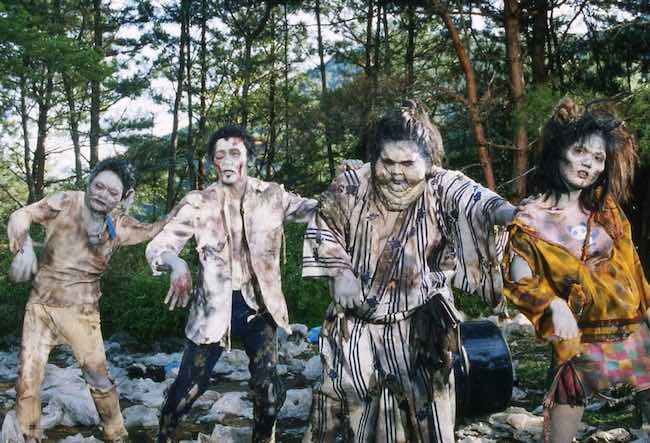
Okay, the one on the right is kind of serving though.
The film also utilises something very novel: claymation stunt performances. This allows Miike to translate ideas like two characters fighting whilst hanging on the side of a cliff, or the family being swept away in a mudslide (dog and all) with creative abandon. It’s something I’ve genuinely never seen before, and in any other film it would’ve been incredibly jarring – but here it seems as natural as any other insanity on screen. I am an advocate for stop-motion in film, and I think we should be more open to using it in the modern day. No-one has an issue suspending their disbelief with any of Ray Harryhausen’s work, and filmmakers like Paul Verhoeven (RoboCop) and Wes Anderson (The Life Aquatic with Steve Zissou) have blended stop-motion into their live action pictures. Yes, it’s more apparent and playful here, but it works. Let your form be weird, people!
Miike injects gag after gag after gag into the film. At its climax, the police arrive and the family believe they are here to arrest them – not knowing the guest they have just welcomed is a murderer. After song-fighting over who will take the blame, Jinpei offers himself as a sacrificial lamb… only to be completely ignored by the cops. The murderer takes Terue hostage, and after a fight, Masayuki is stabbed and dramatically reconciles with his father before his death… only to discover, to quote Monty Python, that it’s only a flesh wound. It’s pretty awkward; I think I would’ve passed away just to avoid the embarrassment. And then a volcano erupts – obviously the natural next step in this unpredictable (read: genuinely baffling) story. The film ends with a reflection on happiness as togetherness, as the family forge on despite their hardships, although there is a little caveat to remember that life is temporary.
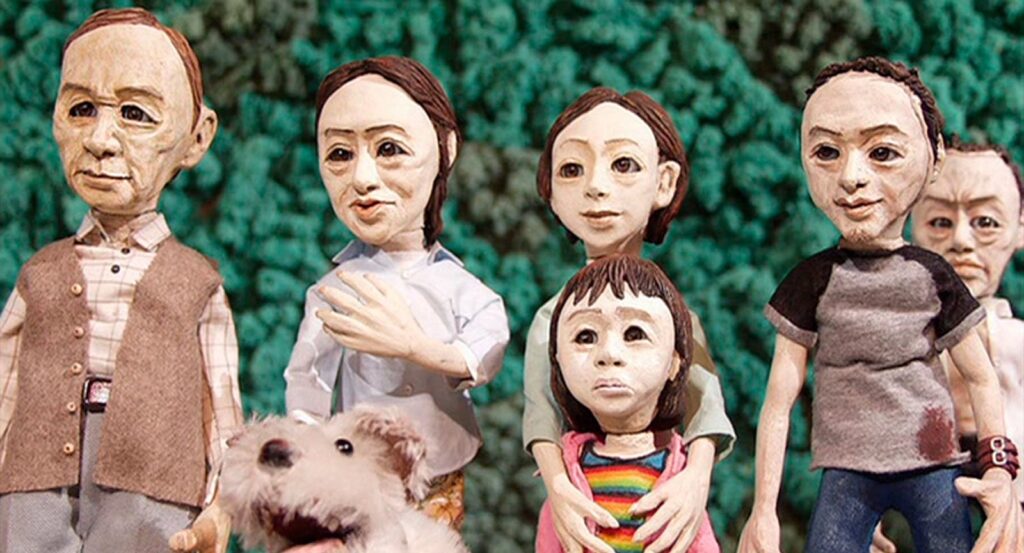
That relatable moment when you all survive a volcanic eruption by turning into puppets.
This is absolutely not a film for everyone. Thankfully, I’m the kind of freak who enjoys this Frankenstein’s-monster hybrid of genre, tone and style, and it’s helped by genuinely great performances which enhance the believability of the family dynamic at the centre. No, the Katakuris aren’t perfect, but they still love and stand by each other throughout their misadventures. Also, the retro fashion is perfectly tailored to the current moment; Pinterest girlies, I expect to see some fits on the platform shortly! Miike demonstrates that he is unafraid to try anything – or maybe everything – and hope that it sticks. It doesn’t entirely – there are a few too many non-sequiturs and the climax is perhaps too random – but there’s more than enough success to be worth the watch for fans of the weird and wonderful. And, after all, isn’t that what Weird Wednesday is all about?
Director: Takashi Miike
Cast: Kenji Sawada, Keiko Matsuzaka, Naomi Nishida
Runtime: 113m
Certificate: 15
Country: Japan
Images: Shochiku
ending when grandad flew into the sky most emotional and beautiful family moment 🙏🙏🙏